WORLD NEWS
Kim Jong Un New Nuclear Plant 2026: North Korea Plans Exponential Weapons Growth What It Means for the World

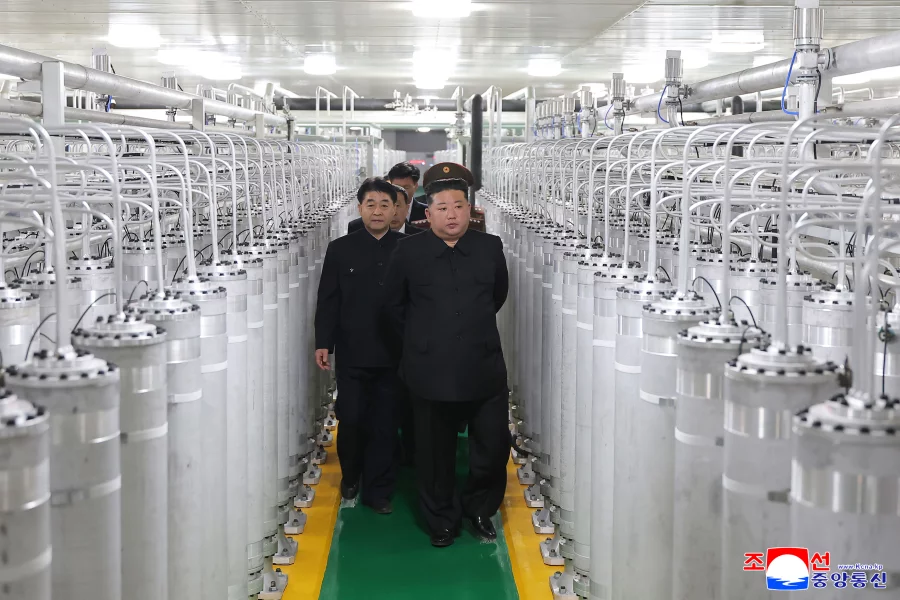
On June 3, 2026, North Korean leader Kim Jong Un visited a brand-new nuclear fuel production facility and made a chilling announcement — his country plans to grow its nuclear forces “at an exponential rate.” The move has alarmed governments from Washington to Seoul and raises a deeply uncomfortable question: how powerful is North Korea’s nuclear program right now, and how much more dangerous can it get?
Here is everything explained in simple terms.
What Happened on June 3, 2026?
Kim Jong Un inspected a new plant that makes weapons-grade nuclear material on June 3 and said North Korea plans to grow its nuclear forces “at an exponential rate,” according to a report from the country’s state-run Korean Central News Agency (KCNA).
The North Korean leader also said that his country has more than doubled its capacity to produce weapons-grade nuclear material in the past five years, and that the new plant will help strengthen its nuclear war deterrent.
State media released photos showing Kim walking through narrow aisles lined with dense rows of silver tubes and pipes, which analysts quickly identified as a centrifuge hall used to enrich uranium to weapons-grade levels. Another photo showed him speaking with senior officials in front of a blurred graphic that appeared to show a cone-shaped object, possibly a warhead design.
During the visit, Kim said the urgency for growing the country’s nuclear war deterrent has increased because of confrontations with “the most ferocious enemies” — an apparent reference to the United States and South Korea.
What Is a Uranium Enrichment Plant And Why Does It Matter?
To understand why this matters, you need to understand what uranium enrichment actually is. Natural uranium dug from the ground is not powerful enough to make a nuclear bomb. To make weapons-grade material, it must be processed in centrifuges, machines that spin uranium gas at extremely high speeds to separate out the most powerful atoms.
The more centrifuges a country has running, the faster it can produce weapons-grade uranium. More uranium means more nuclear bombs. This is exactly why the international community has spent decades trying to stop countries like Iran and North Korea from building these facilities.
KCNA said the new facility used “more sophisticated technology” but did not provide further details such as its location. South Korea’s Joint Chiefs of Staff assessed the site as a uranium enrichment plant and said it was closely coordinating with the United States to monitor North Korean nuclear activities.
It is the third time North Korea has disclosed a uranium enrichment site. The first was in 2010 when North Korea showed one at its main Yongbyon nuclear complex to visiting American scholars, and the second was in 2024 when North Korea released photos of another covert uranium enrichment plant, which experts believe was at its Kangson complex.
How Many Nuclear Weapons Does North Korea Have Right Now?
This is the question everyone is asking. The honest answer is: nobody knows exactly because North Korea is one of the most secretive countries on earth. But here is what experts estimate based on available evidence.
Experts estimate that North Korea might have produced sufficient fissile material for at least 90 warheads and may have approximately 60 assembled warheads, although this number is almost certainly increasing.
In April 2026, a US defense official testified that “North Korea’s nuclear forces are increasingly capable of targeting the US Homeland, and its missile forces can strike South Korea and Japan with nuclear or conventional warheads.” The 2026 National Defense Strategy stated that these forces are “growing in size and sophistication, and they present a clear and present danger of nuclear attack on the American Homeland.”
| Country | Total Warheads (2026) | Status |
|---|---|---|
| Russia | ~5,580 | World’s largest arsenal |
| United States | ~5,044 | 2nd largest |
| China | ~500 | Rapidly expanding |
| France | ~290 | Stable |
| UK | ~225 | Stable |
| North Korea | ~60 assembled (material for 90+) | 🔴 Rapidly expanding |
| Pakistan | ~170 | Slowly growing |
| India | ~172 | Slowly growing |
Can North Korea Actually Hit the United States?
This is the most important and most debated question among defence experts. The short answer: probably yes — and that is why this new plant is so alarming.
Since his first round of nuclear diplomacy collapsed in 2019, Kim has carried out a provocative run of weapons tests and vowed repeatedly to “exponentially” expand the country’s nuclear arsenal. This has led many experts to believe North Korea now likely has nuclear missiles capable of striking the US mainland.
Kim instituted the push for more nuclear weapons under a five-year plan implemented after denuclearization talks with the United States, including three meetings with US President Donald Trump during his first term, ended in failure. Kim praised the country’s nuclear scientists for delivering on the goals of that plan and said North Korea’s nuclear potential is now “inconceivable.”
However, some experts urge caution. Not all analysts are convinced North Korea has fully mastered every technology needed to reliably deliver a nuclear warhead to US soil. The missile must survive re-entry through the atmosphere — a challenge that remains unverified by North Korea through open testing.
What Is North Korea’s History With Nuclear Weapons?
North Korea’s nuclear program did not start overnight. It has been decades in the making — and every diplomatic effort to stop it has failed.
North Korea withdrew from the Nuclear Non-Proliferation Treaty in 2003 and conducted its first nuclear test in 2006. Since then, it has carried out six nuclear tests, with the most recent and most powerful in 2017 estimated at 140 to 250 kilotons, making it a hydrogen bomb roughly 10 to 15 times more powerful than the bombs dropped on Hiroshima and Nagasaki.
Between 2018 and 2019, there was genuine hope of progress. Kim Jong Un held three historic summits with then-President Donald Trump, meetings that produced dramatic images but no real agreements. The diplomacy collapsed completely in February 2019 in Hanoi, Vietnam, when the two sides could not agree on a deal.
Since then, North Korea has accelerated its weapons program at a pace that has alarmed the entire region.
The US Forces Korea commander said in April 2025 that in return for North Korea’s assistance in Russia’s war against Ukraine, “Russia is expanding sharing of space, nuclear, and missile-applicable technology, expertise, and materials to North Korea.” This Russia-North Korea technology transfer is considered one of the most serious new threats in the nuclear landscape.
Why Is This New Plant Significant — And What Makes It Different?
In an April 2026 statement to the House Armed Services Committee, the US Defense Intelligence Agency director said: “Pyongyang is also building a probable additional uranium enrichment facility at Yongbyon to increase stockpile production.” Fissile material production in large part determines the number and type of nuclear warheads a country is able to build.
The significance of the June 3 plant visit goes beyond just showing off a new building. By publicly revealing this facility — with Kim himself walking through it on camera — North Korea is sending a deliberate political message to the world: we are a nuclear power, we are not negotiating this away, and we are only getting stronger.
The nuclear plant’s disclosure implies that Kim is eager to cement his country’s status as a nuclear power and has no intentions of placing his bomb program on the negotiating table.
What Is the US Response?
The Trump administration has not made any major public statement specifically about the June 3 plant visit as of this writing. However, the broader US position on North Korea has been one of deep concern.
South Korea’s Joint Chiefs of Staff said they were closely coordinating with the United States to monitor North Korean nuclear activities following the plant disclosure. The US has maintained strict economic sanctions on North Korea for years, but those sanctions have clearly failed to stop the nuclear program from advancing.
North Korea’s rise as a nuclear power is something the Trump administration has pointed to repeatedly as a reason why it is trying to stop Iran from following the same path most recently through Operation Epic Fury, its military operation against Iran earlier in 2026.
What Does This Mean for the Rest of the World?
The implications of a rapidly expanding North Korean nuclear arsenal go far beyond the Korean peninsula. Here is what this means for different regions:
For South Korea and Japan: Both countries sit within easy missile range of North Korea. South Korea has been in talks about developing its own nuclear deterrent — a conversation that will now intensify significantly after this announcement.
For the United States: The 2026 National Defense Strategy already identified North Korea as a “clear and present danger” of nuclear attack on the American Homeland. More enrichment capacity means more warheads — and more warheads mean a more complicated military deterrence equation for Washington.
For China: Beijing has historically acted as a buffer between North Korea and the rest of the world. But as North Korea’s program expands, China’s ability to control its neighbor’s behavior is increasingly in question.
For global arms control: Every new North Korean warhead is another blow to the global nuclear non-proliferation framework. If North Korea successfully cements its status as a permanent nuclear power without serious consequences, it creates a template that other countries could follow.
Frequently Asked Questions: Kim Jong Un Nuclear Plant 2026
Q: What did Kim Jong Un do on June 3, 2026?
Kim Jong Un visited a new nuclear fuel production facility in North Korea and announced plans to grow the country’s nuclear forces “at an exponential rate.” He said North Korea had more than doubled its capacity to produce weapons-grade nuclear material in five years.
Q: What type of facility did Kim Jong Un visit?
South Korea’s Joint Chiefs of Staff assessed the facility as a uranium enrichment plant — the type of facility that produces weapons-grade uranium for nuclear bombs. The location was not disclosed publicly.
Q: How many nuclear weapons does North Korea have in 2026?
Experts estimate North Korea has approximately 60 assembled nuclear warheads and enough fissile material for 90 or more. The exact number is unknown because North Korea does not publish this information.
Q: Can North Korea’s missiles reach the United States?
Most experts believe North Korea likely has ICBMs capable of reaching the US mainland, though some debate whether all the necessary technology has been fully mastered and tested. The US 2026 National Defense Strategy called North Korea a “clear and present danger” to the American Homeland. According to the Federation of American Scientists’ 2026 Nuclear Warhead Inventory, North Korea currently has material for at least 90 warheads and this number is actively growing.
Q: Has any country’s diplomacy stopped North Korea’s nuclear program?
No. Multiple rounds of sanctions, three Trump-Kim summits (2018-2019), six-party talks, and United Nations resolutions have all failed to stop or reverse North Korea’s nuclear development. The program has accelerated after each failed diplomatic effort.
Q: What happens if North Korea keeps expanding its nuclear arsenal?
Analysts at RAND Corporation project North Korea could have 200 nuclear weapons by 2027, and experts at Carnegie Endowment for International Peace project 300 warheads by the mid-2030s, which would make it comparable to the United Kingdom and France in terms of arsenal size.
Also Read: US-Iran War 2026: How It Started, What It Cost, and Where It Stands Today




 WORLD NEWS2 weeks ago
US-Iran War 2026: How It Started, What It Cost, and Where It Stands Today

 Tech5 days ago
Best Free AI Tools Everyone Is Using in 2026.

 Trending2 weeks ago
You’re Not Imagining It :Rising Prices 2026 Are Making Your Paycheck Feel Smaller

 Tech4 days ago
SpaceX New IPO 2026: Everything You Need to Know Before Investing Date, Price, Ticker and Risks