WORLD NEWS
Colombia Presidential Election 2026: First Round Results, Runoff Date and What It Means

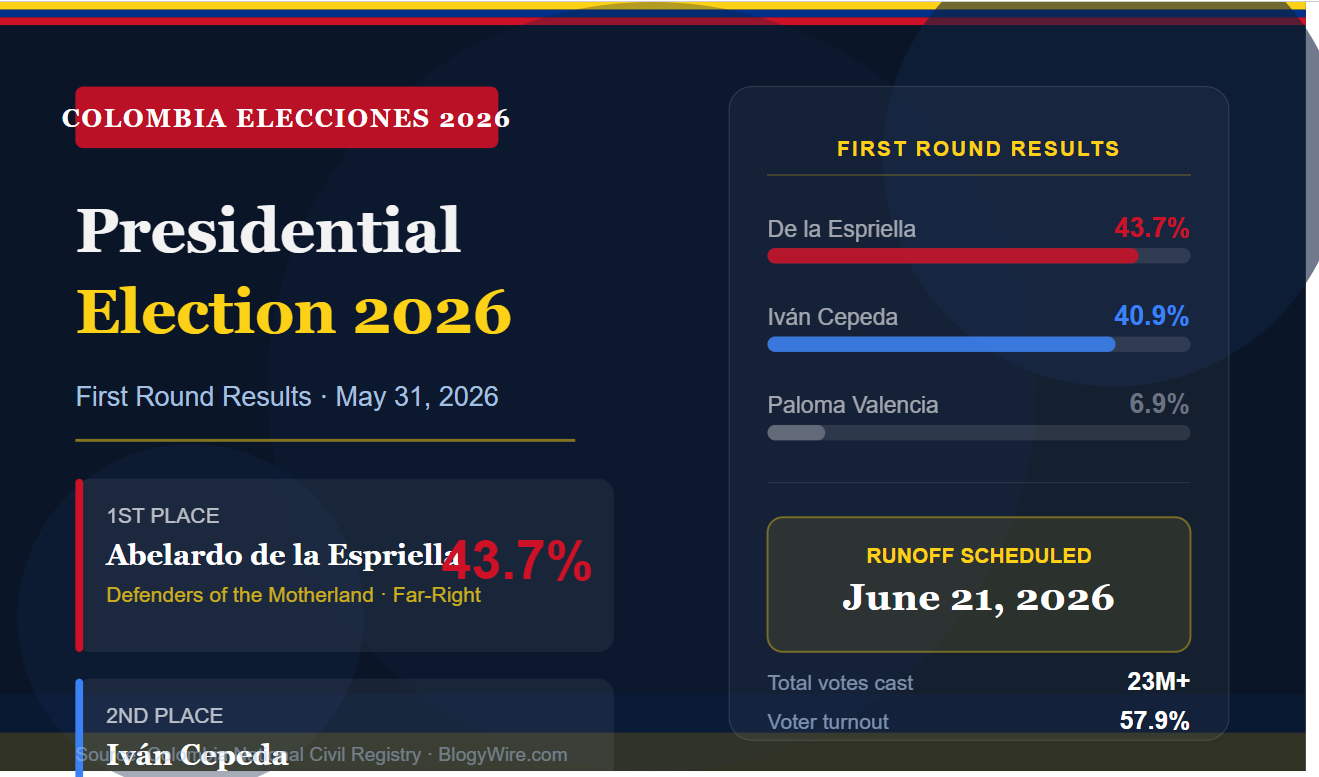
Colombia held its presidential election on May 31, 2026 — and the result shocked the world. Far-right outsider Abelardo de la Espriella topped the first round with 43.7% of the vote, comfortably beating pollsters’ predictions. Left-wing Senator Iván Cepeda came second with 40.9%. Since neither candidate crossed the required 50% majority threshold, the two will now face each other in a runoff election on June 21, 2026.
What Happened in Colombia’s May 31 Election?
On May 31, 2026, millions of Colombians went to the polls to choose their next president. With incumbent president Gustavo Petro constitutionally barred from seeking a second term, over 13 candidates entered the race. The contest quickly narrowed to three main names — but the final result surprised almost everyone.
Less than two hours after polling stations closed, the runoff was confirmed. De la Espriella — a criminal defense lawyer who had never held elected office — topped the first round in a stunning upset. More than 23 million Colombians voted, representing approximately 57.9% of registered voters — a strong turnout by the country’s standards.
Colombia uses a two-round election system. If no candidate receives more than 50% of the vote in the first round, the top two candidates face each other in a runoff. Since no candidate crossed that threshold on May 31, the runoff between de la Espriella and Cepeda is now scheduled for June 21, 2026.
Full First Round Results: Colombia Presidential Election 2026
With 98% of votes counted, the National Civil Registry confirmed the following results. De la Espriella secured 10,192,087 votes — the highest of any candidate. Cepeda trailed by more than 600,000 votes. Center-right Senator Paloma Valencia finished a distant third with just 6.9%, and centrist Sergio Fajardo came fourth.
| Candidate | Party | Votes | % Share | Result |
|---|---|---|---|---|
| Abelardo de la Espriella | Defenders of the Motherland | 10,192,087 | ✅ Runoff | |
| Iván Cepeda | Historic Pact | 9,600,000+ | ✅ Runoff | |
| Paloma Valencia | Democratic Center | 1,600,000+ | ❌ Eliminated | |
| Sergio Fajardo | Independent / Centrist | 1,000,000+ | ❌ Eliminated |
Who Are the Two Runoff Candidates?
Who Is Abelardo de la Espriella?
De la Espriella is a criminal defense lawyer and businessman from the coastal city of Barranquilla. He has never held elected office — making his first-place finish one of the biggest political upsets in recent Colombian history. He modeled his entire campaign after Donald Trump and El Salvador’s Nayib Bukele, speaking behind bulletproof glass at rallies and using aggressive anti-crime rhetoric.
His key policy promises include resuming aerial fumigation of coca fields with glyphosate — halted under Petro — building megaprisons, adopting an iron-fist approach to crime, and completely ending Petro’s peace negotiations with guerrilla groups and cartels.
Who Is Iván Cepeda?
Cepeda, 63, is a veteran senator representing Bogotá since 2014 and the official candidate of President Petro’s ruling Historic Pact coalition. A vote for Cepeda is effectively a vote for a continuation of Petro’s leftist agenda under a new face.
His personal history is deeply tied to Colombia’s violent past. His father, Manuel Cepeda, was a senator and member of Colombia’s Communist Party who was assassinated by paramilitaries in 1994 — a defining tragedy that shaped the younger Cepeda’s life in politics and human rights activism. Cepeda promotes continued peace negotiations with guerrilla groups and has been accused by opponents of having ties to the FARC — accusations he firmly denies.
Why Did De la Espriella Win the First Round?
Security and crime were the dominant voter concerns heading into May 31. Despite Colombia’s landmark 2016 peace deal with FARC guerrillas bringing enormous hope, violence surged back under Petro’s government as armed groups exploited ongoing peace talks to expand territorial control across the country.
Colombians are also watching a broader Latin American shift — Argentina elected Javier Milei in 2023, El Salvador re-elected Bukele in 2024 with a massive majority, and now Colombia appears to be following the same pattern: turning to outsider, security-focused, anti-establishment candidates who promise to get tough on crime.
What Controversy Followed the Election Results?
The results were not accepted quietly by the losing side. Left-wing candidate Iván Cepeda refused to acknowledge the preliminary results, claiming “atypical voting patterns” at some polling stations. He called on Colombia’s youth to join his cause and declared “We will not hand Colombia over to fascism.”
Outgoing president Gustavo Petro went even further, posting on X (formerly Twitter) that he would not accept the preliminary vote count, alleging that “hundreds of thousands of votes were added” and claiming flaws in vote-counting software.
What Happened to Paloma Valencia — and Why Does It Matter?
Center-right senator Paloma Valencia — backed by former president Álvaro Uribe and the first woman ever nominated by the Democratic Center party — finished a distant third with just 6.9% of the vote. Shortly after results came in, Valencia officially endorsed de la Espriella, urging voters not to let “new communism” continue in Colombia. However, her running mate, centrist technocrat Juan Daniel Oviedo, did not follow her lead — leaving the door open for some of her 1.6 million voters to shift to Cepeda in the runoff.
Centrist candidate Sergio Fajardo’s 1 million+ votes are also up for grabs and could prove decisive in what is expected to be an extremely tight second round.
What Does This Mean for Colombia and the United States?
The June 21 runoff is being watched globally. The Trump administration has placed enormous pressure on Latin American governments to cooperate on drug enforcement, migration control, and regional security. A de la Espriella victory would deliver a major foreign policy win for Washington — a pro-Trump ally in one of South America’s most strategically important countries, with direct implications for coca eradication, extradition of drug lords, and US-Colombia military cooperation.
A Cepeda victory, on the other hand, would mean continued friction with Washington on drug policy, Venezuela relations, and regional security. For background on the broader relationship, see the Council on Foreign Relations overview of US-Colombia relations.
What Happens Next — The June 21 Runoff
The runoff on June 21, 2026, is genuinely too close to call. De la Espriella’s 43.7% vs. Cepeda’s 40.9% represents a gap of roughly 600,000 votes, but both candidates must now win over the voters of eliminated candidates to secure a majority. Key factors that will decide the runoff:
- Valencia’s 1.6 million votes: She endorsed de la Espriella, but her moderate running mate did not. How many of her voters follow her endorsement is the biggest variable going into June 21.
- Fajardo’s 1 million votes: These centrist voters could swing either way — or simply stay home on runoff day.
- Voter turnout: Higher turnout historically favors left-wing candidates in Colombia. Lower turnout tends to benefit the right.
- Security incidents: Any major violent event in the three weeks before June 21 could dramatically shift momentum toward de la Espriella.
Colombian political strategist Miguel Jaramillo Lujan summed it up simply: both finalists “must tread carefully in the next three weeks to prevail.”
Frequently Asked Questions — Colombia Presidential Election 2026
Q: Who won the Colombia presidential election 2026? No one won outright. Abelardo de la Espriella led the first round with 43.7% and Iván Cepeda came second with 40.9%. The winner will be decided in the runoff on June 21, 2026.
Q: When is the Colombia presidential runoff 2026? The runoff election between de la Espriella and Cepeda is scheduled for June 21, 2026.
Q: Who is Abelardo de la Espriella? He is a criminal defense lawyer and businessman from Barranquilla who has never held elected office. He modeled his campaign after Trump and Bukele, running on a platform of tough security and anti-crime policies.
Q: Why can Gustavo Petro not run again in 2026? Colombia’s constitution bars a sitting president from seeking a consecutive second term. Petro was elected in 2022 and is constitutionally ineligible to run in 2026.
Q: How many people voted in Colombia’s 2026 presidential election? More than 23 million Colombians voted — approximately 57.9% of registered voters — a strong turnout by the country’s standards.
Q: What happens if de la Espriella wins the June 21 runoff? A de la Espriella victory would mark a sharp right-wing shift in Colombia — with closer ties to the US Trump administration, a return to aerial coca fumigation, megaprisons for criminals, and an end to Petro’s peace negotiations with guerrilla groups.
Visit Blogy Wire for more news like this.




 WORLD NEWS3 weeks ago
US-Iran War 2026: How It Started, What It Cost, and Where It Stands Today

 Tech6 days ago
Best Free AI Tools Everyone Is Using in 2026.

 Trending3 weeks ago
You’re Not Imagining It :Rising Prices 2026 Are Making Your Paycheck Feel Smaller

 Tech5 days ago
SpaceX New IPO 2026: Everything You Need to Know Before Investing Date, Price, Ticker and Risks